
A lot of men don’t look for “wellness trends.” They look for results.
Maybe your back keeps flaring up. Maybe your shoulders feel like concrete after long workdays. Maybe you are sleeping but not recovering. Or maybe you are doing everything “right” and still feel tense, wired, and worn down.
That is where acupuncture often enters the conversation. Not as magic. Not as a replacement for medical care. More like a practical tool that can support pain relief, recovery, stress regulation, and sleep when it is used the right way.
What acupuncture is (in plain English)
Acupuncture is a treatment where very thin, sterile needles are placed at specific points on the body. The goal is to create a therapeutic response through the nervous system and local tissues.
Most men want the simple explanation, so here it is.
- It can help your nervous system shift gears. Many people walk in “revved up” and leave feeling calmer. That calm is not just in your head. Your body has built-in systems for downshifting.
- It can influence how pain signals are processed. Pain is not only about damage. It is also about how your brain and nerves interpret signals. Acupuncture can affect that process.
- It can reduce muscle guarding and improve local circulation. When a muscle is stuck in a tight, protective pattern, it can keep pain going. Getting that pattern to relax can be a turning point.
None of this guarantees the same outcome for every person. The more accurate promise is this: acupuncture may help, especially when the issue involves pain, tension, stress, or sleep disruption.
Pain and mobility benefits men commonly seek
Most men do not book acupuncture because they love needles. They book because something hurts and they are tired of working around it.
Back, neck, and “desk-body” tension
If your work involves a desk, a vehicle, tools, or repetitive movement, you have probably felt the classic combination:
- tight neck and upper shoulders
- stiff mid-back
- low-back tightness
- tension headaches that feel like they start in the shoulders
Acupuncture may help by reducing the intensity of the tension pattern and lowering how alert your nervous system stays around that area. Many men notice fewer flare-ups, easier movement, and less constant background tightness.
A realistic way to think about it is this: if your body has been bracing for months, you are not going to unwind it in one appointment. But you can start changing the pattern.
Sports and gym-related aches (overuse and recovery support)
Training is good. Overuse is not.
Men often try acupuncture when they have:
- recurring tightness that comes back after workouts
- nagging aches that linger despite stretching
- overload patterns from repetitive sports or high training volume
Acupuncture is commonly used as support, not as the full plan. It can reduce pain and tension enough to let you move better, train smarter, and actually do the strengthening or rehab work you need.
A simple comparison helps. If your check-engine light is on, acupuncture may reduce the noise so you can move comfortably, but you still want the underlying issue addressed. For the body, that “fix” might be strength training, physiotherapy, mobility work, or changes in technique and load.
Headaches and jaw tension
Jaw clenching, teeth grinding, and “tight face” stress are more common than most men admit.
When the jaw and neck are tense, headaches often follow.
Acupuncture may help by reducing tension through the jaw, neck, and upper back, and by calming the stress response that fuels clenching.
If headaches are new, severe, or changing in pattern, do not self-manage. Get them assessed.
Stress, mood, and the mental load
Men do not always describe stress with emotional language. Many describe it through symptoms:
- “I cannot switch off.”
- “I am always tense.”
- “I am snapping at people.”
- “I am exhausted but wired.”
“Wired but tired”: downshifting the stress response
One of the most common reasons men keep coming back is how acupuncture can change the way they feel in their own body after a session.
Many describe it like finally taking their foot off the gas pedal. That calmer baseline can create a ripple effect: less jaw tension, fewer tension headaches, and easier sleep.
Not everyone feels it immediately. Some feel it after a few sessions. But when it works, it often feels like your system becomes less reactive.
Burnout patterns that show up as physical symptoms
Stress often hides inside physical problems:
- shoulder and neck tightness
- digestive discomfort
- low-grade headaches
- chest tightness
Important note: chest symptoms should never be brushed off. If chest tightness is new, intense, or concerning, seek medical care.
Acupuncture may help with the stress component, especially when combined with lifestyle changes and other supports.
Sleep and energy
Sleep is where the body repairs itself. Pain improves, recovery happens, hormones regulate, mood stabilizes.
When sleep is off, almost everything feels harder.
Falling asleep vs staying asleep
These are different problems.
- Trouble falling asleep often relates to stress, stimulation, or a nervous system that will not downshift.
- Waking up during the night can be connected to stress, pain, breathing issues, habits, or broader health conditions.
Acupuncture may help by calming the system and reducing pain that disrupts sleep.
Daytime energy and recovery
Some men report steadier energy after a few sessions, especially when fatigue is tied to poor sleep, chronic pain, or high stress.
If fatigue is persistent, intense, or unexplained, treat it as a medical question, not a motivation problem. Get it checked.
Performance-adjacent benefits (careful and realistic)
Acupuncture sometimes gets marketed like a performance hack. That is where hype can creep in.
Let’s keep it grounded.
Focus and mental clarity
When stress is high and sleep is poor, focus drops. If acupuncture helps you downshift and sleep better, focus often improves indirectly.
That is not the same as claiming acupuncture “boosts intelligence.” It is more like clearing fog by fixing the basics.
Libido and sexual function: what acupuncture may support
This topic deserves a calm, mature approach.
Acupuncture may help some men through indirect pathways:
- reducing stress, which is a common libido killer
- improving sleep
- reducing pain that makes intimacy uncomfortable
But erectile dysfunction, sudden changes, pain, or other red flags should be evaluated medically. Acupuncture can be a complement, not a substitute.
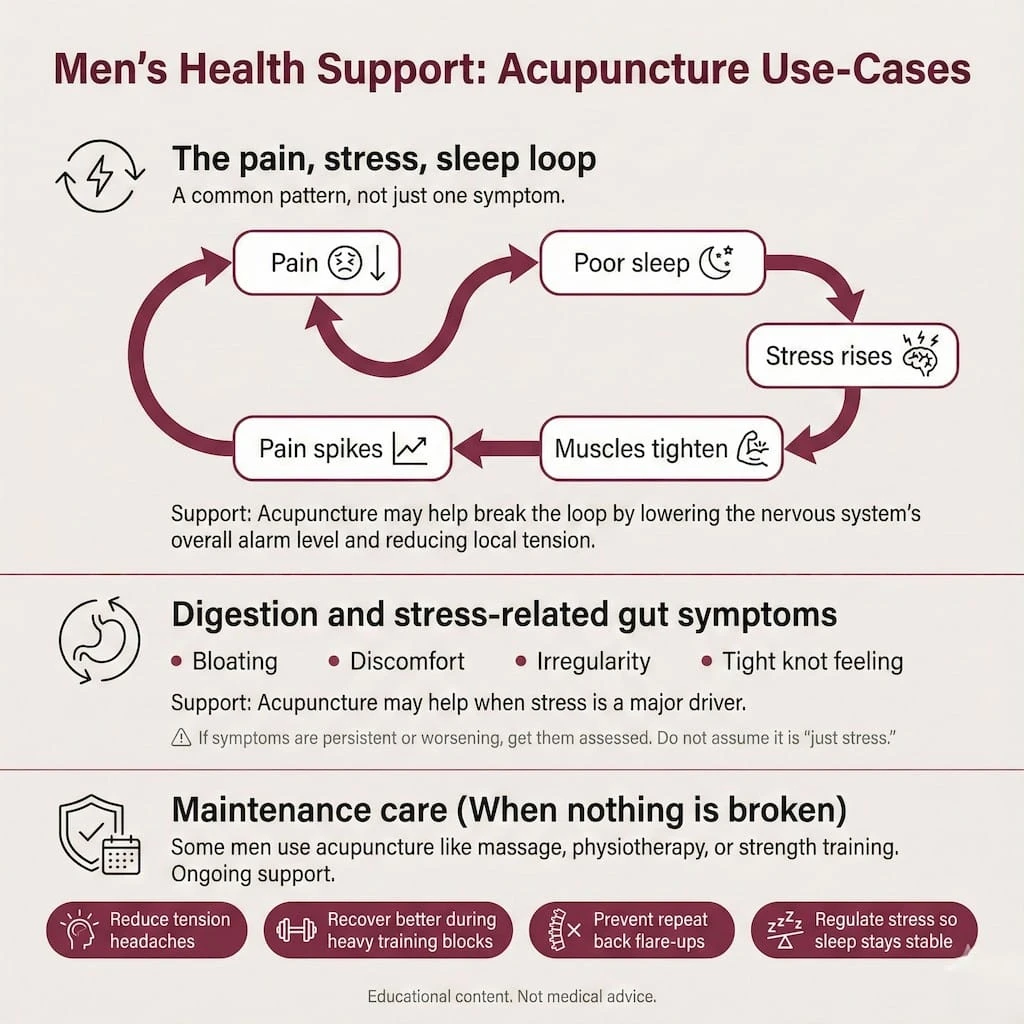
Men’s health support use-cases
Men often come in with one main complaint, but the real issue is a pattern.
The pain–stress–sleep loop
This loop is brutal:
- pain makes sleep worse
- poor sleep increases pain sensitivity
- stress rises
n- muscles tighten - pain spikes
Acupuncture may help break the loop by lowering the overall alarm level in the nervous system and reducing local tension.
Digestion and stress-related gut symptoms
The gut and nervous system are closely connected. Stress can show up as bloating, discomfort, irregularity, or a tight knot feeling.
Acupuncture may help when stress is a major driver.
If symptoms are persistent or worsening, get them assessed. Do not assume it is “just stress.”
Maintenance care (when nothing is broken)
Some men use acupuncture the same way they use massage, physiotherapy, or strength training: as maintenance.
This approach tends to work best when you have clear goals, such as:
- reduce tension headaches
- recover better during heavy training blocks
- keep back flare-ups from repeating
- regulate stress so sleep stays stable
What the evidence says (without turning it into a research paper)
Acupuncture has the strongest support and most common clinical use in areas like pain management, especially musculoskeletal pain.
For stress, sleep, and performance-adjacent topics, evidence can be more mixed, and the effect is often indirect.
Here is the practical, honest takeaway:
- If your main issue involves pain, tension, stress patterns, or sleep disruption, acupuncture is often worth a trial.
- If you expect a guaranteed transformation in one session, you will probably be disappointed.
- If you combine acupuncture with good movement, rehab, sleep habits, and appropriate medical care, it often fits well.
What a first session looks like
Men often avoid acupuncture because they do not know what will happen. The unknown feels worse than the needles.
Intake: what you will be asked
Expect questions about:
- where you hurt and how long it has been going on
- sleep quality and energy
- stress levels and work demands
- exercise history and training volume
- previous injuries and what has helped so far
Good practitioners do not guess. They assess.
Needles: what it feels like
Most men describe it as:
- a tiny pinch or pressure
- a dull ache, heaviness, warmth, or “buzz” at certain points
You should not feel sharp ongoing pain. If something feels wrong, speak up.
After the session
Normal reactions include:
- deep calm
- mild soreness at needle sites
- temporary fatigue
- or no obvious change on day one
No immediate change does not mean it failed. Many men notice the difference after a few sessions, especially with chronic issues.
How many sessions are typically needed?
It depends on the goal and how long the problem has been there.
- Acute flare-ups: sometimes a few sessions close together helps settle things.
- Chronic issues: usually requires a longer approach, because the pattern has been built over time.
A practical trial window is often 3 to 6 sessions before making a judgment.
Track something measurable:
- pain level (0 to 10)
- sleep hours and quality
- headache frequency
- range of motion and stiffness
- training recovery
If nothing is changing by that point, the plan should be adjusted.
Safety, side effects, and when to avoid acupuncture
Acupuncture is generally safe when performed by a licensed professional using sterile needles.
Common mild effects:
- small bruises
- temporary soreness
- temporary fatigue
Be cautious and get medical advice when appropriate if you have:
- bleeding concerns or you are on blood thinners
- signs of infection or fever
- sudden neurological symptoms
- serious chest symptoms
If you are unsure, ask your healthcare provider.
How to choose the right acupuncturist
Results depend on the practitioner and the plan.
Look for:
- proper licensing and a professional, clean environment
- experience with your main goal (pain, stress, sports recovery)
- clear communication and consent
- a plan that makes sense, not vague promises
- transparent pricing and scheduling
You are not looking for someone who says yes to everything. You are looking for someone who can explain why they are doing what they are doing.
Three mini examples (realistic and relatable)
1) The desk worker with neck tension and bad sleep
He feels tight through the shoulders and jaw. Sleep is light and broken. He wakes up already tired.
Focus: reduce tension and calm the system enough to sleep more deeply.
2) The active guy with recurring knee or hip pain
He trains hard and rests poorly. Pain is not severe, but it keeps coming back.
Focus: reduce pain and tightness so strengthening and load management can actually work.
3) The new dad who is exhausted and tense
Sleep is fragmented and stress is high. His back feels stiff from carrying and awkward positions.
Focus: support recovery, reduce tension, and stabilize sleep quality.
The realistic benefits men can expect
For many men, acupuncture is most useful for pain, tension, stress regulation, and sleep support. It is not a miracle button, but it can be a strong tool when paired with smart movement, rehab, and real-life habit changes.
If you are looking for acupuncture in North Vancouver and you want a straightforward, results-focused approach, our team can help you figure out whether acupuncture belongs in your plan. We focus on clear goals, measurable progress, and care that fits real life. Book an appointment, ask questions, and start with a short trial so you can judge the results for yourself.
FAQs
Does acupuncture actually work for men?
It can, especially for pain and tension-related issues. Results vary, and a short trial period is usually the most practical way to judge.
Can acupuncture help with back pain or neck pain?
It may help reduce pain intensity and muscle tension, particularly when combined with movement and rehabilitation.
Does acupuncture help with stress and anxiety?
Many men report feeling calmer after sessions. It may help downshift the stress response, which can improve sleep and reduce tension.
Can acupuncture improve sleep?
It may help with stress-related insomnia or pain-related sleep disruption. Ongoing or severe sleep problems should be assessed medically.
How many sessions should I try before deciding?
A common trial window is 3 to 6 sessions, while tracking measurable changes like pain level, sleep quality, or headache frequency.