Medical Disclaimer: The information provided in this article is for educational purposes only and is not intended as medical advice, diagnosis, or treatment. Always seek the advice of a qualified health provider with any questions you may have regarding a medical condition. Maintaining optimal mobility is essential, and understanding the mechanics of your gait is the first step toward long-term health. At Capilano physiotherapy clinic, we specialize in assessing these patterns and providing evidence-based care for patients of all ages.
As a parent, watching your child take their first steps is a monumental milestone. However, that excitement can quickly turn to concern if you notice your child consistently walking on the balls of their feet. Often referred to as tip toe walking, this gait pattern is a common reason for clinical visits. While it is frequently a normal part of development, persistent toe walking requires a professional eye to ensure it doesn’t lead to long-term mechanical issues.
I. Understanding the Equinus Gait
In clinical terms, toe walking is known as an “equinus gait.” It is characterized by the absence of a “heel strike” at the start of a step. Instead of the foot landing on the heel and rolling forward, the person lands on the forefoot or midfoot.
In the first few months of walking (usually between 12 and 15 months), children are still learning how to coordinate their bodies. It is perfectly normal for a toddler to experiment with different foot positions. At this stage, it is often just a sensory experiment or a way to find balance. However, when this pattern persists beyond the age of three, it transitions from a developmental phase into a clinical observation.
II. Developmental vs. Persistent Toe Walking
The Normal Developmental Phase
Most children who walk on their toes between the ages of one and three are simply developing their motor skills. They may do it when they are barefoot on cold tiles or when they are excited. In most cases, if the child can walk flat-footed when asked and shows no other developmental delays, it is considered a passing phase.
Idiopathic Toe Walking (ITW)
When a child continues to walk on their toes with no identifiable neurological or physical cause, we call it Idiopathic Toe Walking (ITW). This is essentially a “habitual” gait. While “habit” sounds simple, the physiological result is real: the brain has mapped this movement as the “correct” way to walk. Over time, this habit can lead to the shortening of the calf muscles, making it physically difficult to walk flat-footed even if the child wants to.
Red Flags for Parents
You should consider a professional consultation if you notice:
- Your child walks on their toes more than 80% of the time.
- They cannot physically push their heels down to the floor.
- They frequently trip or fall due to their foot position.
- The gait is asymmetrical (one foot is flat, the other is on the toe).
III. The Importance of Specialized Pediatric Care
When addressing gait issues in young children, specialized Pediatric Care is essential. Children’s bodies are constantly growing, meaning their bones, tendons, and muscles are more “plastic” and responsive to intervention than those of adults. A pediatric approach focuses not just on the physical stretch of the muscle, but on developmental play and motor-learning strategies that keep the child engaged. Early intervention through pediatric-focused physiotherapy can prevent the need for more invasive procedures like casting or surgery later in life.
IV. Pathological and Secondary Causes of Toe Walking
It is vital to differentiate between habit and underlying medical conditions. Identifying the specific causes of toe walking is the primary goal of any initial assessment.
Neuromuscular Conditions
The most common medical cause is Cerebral Palsy (CP). In these cases, the muscles are “spastic” or overly tight because the brain is sending constant signals to contract. This prevents the heel from reaching the ground. Other conditions, such as tethered cord syndrome or spinal cord abnormalities, can also present as an equinus gait.
Musculoskeletal Issues
Some children are born with a congenitally short Achilles tendon. In other cases, conditions like Muscular Dystrophy can cause the calf muscles to weaken and tighten simultaneously, forcing the heel upward.
Neurodivergence and Sensory Processing
There is a documented correlation between Autism Spectrum Disorder (ASD) and toe walking. For many neurodivergent individuals, the gait is a sensory response. They may be hypersensitive to the feeling of different textures on their heels, or they may find the “pressure” of walking on their toes to be sensory-regulating.
V. Physical and Long-Term Complications
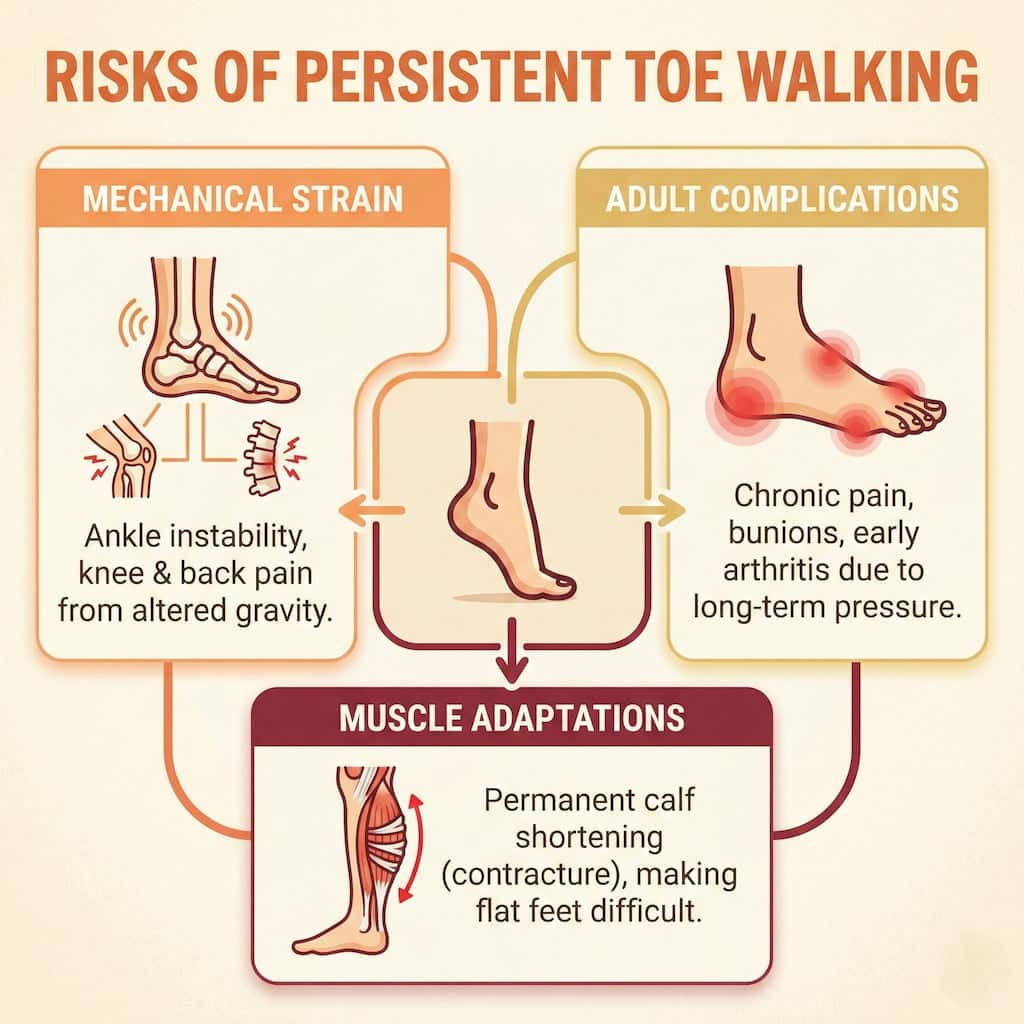
If left unaddressed, persistent toe walking can lead to a cascade of mechanical issues that affect the entire body.
Mechanical Strain
When the heel doesn’t strike the ground, the body loses its natural shock absorber. This places excessive strain on the ankles, which often become unstable. We frequently see compensatory pain in the knees and the lower back as the body tries to adjust its center of gravity.
Muscle Adaptations
The calf muscles (the gastroc-soleus complex) are designed to stretch and contract. If they are held in a shortened position 24/7, they undergo “contracture”: a permanent shortening of the fibers. This makes future correction much more difficult and often necessitates more invasive treatments.
Toe Walking in Adults
While we often focus on children, toe walking in adults is a significant clinical concern. Adults who have toe-walked since childhood often suffer from chronic plantar fasciitis, severe bunions, and early-onset arthritis in the midfoot. Because the adult skeleton is no longer plastic, correcting the gait requires a dedicated combination of manual therapy and orthotic intervention.
VI. Diagnosis and Clinical Evaluation
A thorough evaluation is the only way to determine the best path forward. When you visit a clinic for a gait assessment, we look at several key factors:
- Passive Range of Motion: We check if the ankle can be moved into “dorsiflexion” (toes toward the shin) while the patient is relaxed.
- Neurological Screening: We test reflexes, muscle tone, and strength to rule out underlying conditions like CP.
- Gait Analysis: We observe the patient walking both naturally and when prompted to walk “normally” to see the difference between habit and physical limitation.
For residents seeking physiotherapy North Vancouver, having a local expert who understands your lifestyle (whether you’re hiking the Grouse Grind or walking the seawall) is invaluable. At Capilano physiotherapy clinic, we pride ourselves on being a nice choice for consulting and treatment, offering a supportive environment for both children and adults.
VII. Evidence-Based Interventions
Treatment is never “one size fits all.” It ranges from simple stretching to surgical intervention.
Non-Surgical Approaches
- Physical Therapy: This is the gold standard for ITW. We focus on stretching the posterior chain, strengthening the anterior tibialis (the muscle that lifts the foot), and “retraining” the brain’s gait map.
- Serial Casting: In cases where the tendon is very tight, a series of casts are applied every week, each one moving the foot into a slightly more stretched position.
- Bracing (AFOs): Ankle-Foot Orthoses can be worn during the day to prevent the “push off” that leads to toe walking, forcing a heel-to-toe pattern.
Pharmacological and Surgical Options
In more severe cases, Botox injections can be used to temporarily paralyze and relax the calf muscle, providing a “window of opportunity” for intensive stretching. If all conservative measures fail, a surgical “Achilles lengthening” may be required to manually reset the tendon length.
VIII. Frequently Asked Questions
Is toe walking a sign of autism? While many children with autism walk on their toes, toe walking alone is not a diagnostic criteria for autism. It is simply one possible sensory or motor symptom that warrants further investigation.
When should I worry about my child walking on their toes? If your child is over the age of three and walks on their toes more often than not, or if they seem unable to put their heels down, it is time for a professional assessment.
Can toe walking be corrected in adults? Yes, though it requires more time. Treatment for adults focuses on managing pain, improving ankle mobility, and using custom orthotics to redistribute pressure across the foot.
Does toe walking cause calf pain? Absolutely. Because the calf muscles are constantly engaged and never fully stretched, they can become fatigued and prone to cramping and strain.
If you are concerned about your gait or your child’s walking pattern, don’t wait for the muscles to tighten further. Early intervention is the key to a lifetime of healthy movement.