Medical Disclaimer: The information provided in this article is for educational purposes only and is not intended as medical advice, diagnosis, or treatment. Always seek the advice of a qualified health provider with any questions you may have regarding a medical condition. Understanding the structural health of your spine is a vital step toward long term mobility. At Capilano physiotherapy clinic, we specialize in assessing these patterns and providing evidence-based care for patients of all ages, making us a nice choice for consulting and treatment.
As children enter the rapid growth spurts of their teenage years, changes in posture are common. While many parents dismiss a rounded upper back as simple “slouching,” there is a distinct clinical condition where the curve is not a choice, but a structural change in the bone. This is known as Scheuermann’s Disease, or juvenile kyphosis. Unlike postural kyphosis, which can be corrected with a conscious effort to stand straight, Scheuermann’s involves a rigid deformity that requires professional intervention.
[Read more: What is Kyphosis?]
Anatomy and Pathophysiology
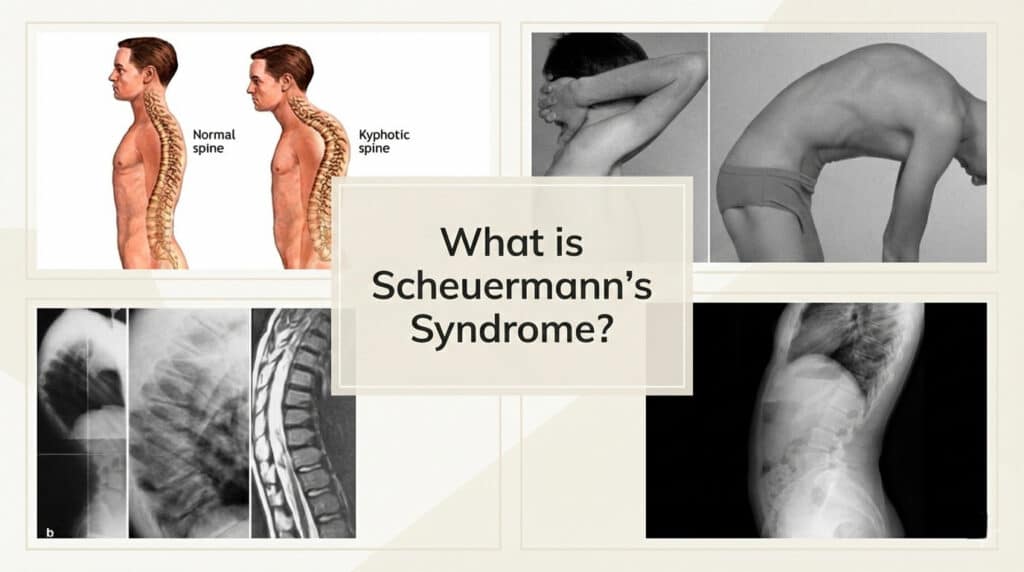
To understand this condition, we must look at the architecture of the spine. A healthy thoracic vertebra is shaped like a rectangle, allowing the spine to stack vertically with a gentle, natural curve. In patients with Scheuermann’s, the front (anterior) part of the vertebrae grows slower than the back (posterior) part.
This uneven growth creates a wedge shape. When several of these wedged vertebrae are stacked, the spine is forced into a sharp forward bend. This process is often accompanied by Schmorl’s nodes (small herniations of the disc into the bone) and irregularities in the vertebral endplates. These structural changes are permanent, meaning the “hump” cannot be flattened simply by pulling the shoulders back.
Symptoms and Visual Indicators
The most prominent sign of Scheuermann’s is hyperkyphosis: an exaggerated rounding of the mid-back. This curve is most visible when the person bends forward, appearing as a sharp, angular peak rather than a smooth, rounded arc.
Beyond the visual curve, patients often report:
- Activity-Aggravated Pain: A dull, persistent ache in the thoracic region that worsens after long periods of sitting or standing.
- Compensatory Mechanics: To balance the forward tilt of the upper back, the lower back often develops an excessive arch (lumbar lordosis).
- Muscle Tightness: Tight hamstrings and pectoral muscles are frequently observed as the body tries to stabilize the altered center of gravity.
The Importance of Specialized Pediatric Care
Because Scheuermann’s typically appears between the ages of 12 and 17, specialized Pediatric Care is the cornerstone of successful management. During this window, the skeleton is still growing, which provides a unique opportunity to influence the final shape of the spine. Pediatric-focused treatment at this stage focuses on core stability and extension exercises that alleviate pressure on the front of the vertebrae. Catching the condition before skeletal maturity (when the bones harden completely) can significantly reduce the severity of the curve in adulthood.
Clinical Diagnosis and Imaging
A professional evaluation begins with a physical exam, specifically the Adam’s Forward Bend Test. During this test, the clinician looks for a “gibbus” deformity: a sharp, localized angulation in the thoracic spine.
To confirm the diagnosis, X-rays are required. Clinicians use the Sorensen criteria, which requires a measurement of at least 5 degrees of anterior wedging in three or more adjacent vertebrae. We also measure the “Cobb Angle” to determine the total degree of the curve. If the curve exceeds 45 to 50 degrees and involves vertebral wedging, a diagnosis of Scheuermann’s is confirmed.
Modern Treatment Paradigms
For those seeking physiotherapy North Vancouver, it is important to choose a clinic that understands the nuances of spinal loading. At Capilano physiotherapy clinic, our treatment approach is tailored to the individual’s skeletal maturity and the severity of their curve.
Conservative Care
For curves under 60 degrees, physical therapy is the primary treatment. We focus on:
- Thoracic Extension: Exercises designed to open the chest and strengthen the muscles that pull the spine upright.
- Core and Pelvic Stability: Reducing the compensatory lumbar lordosis by strengthening the deep abdominal muscles.
- Flexibility: Targeted stretching for the hamstrings and hip flexors.
Bracing and Surgery
If the curve is significant (between 60 and 75 degrees) and the child is still growing, a specialized brace (such as a TLSO) may be prescribed. This brace is worn for most of the day to guide the growth of the vertebrae into a more rectangular shape. Surgery is generally reserved for extreme cases (curves over 75 degrees) where there is a risk of neurological issues or severe, unremitting pain.
Long-Term Prognosis and Adult Impact
While the most aggressive changes happen during adolescence, the effects of Scheuermann’s can persist into adulthood. Adults with untreated or severe kyphosis may experience premature osteoarthritis due to uneven wear on the spinal joints. There is also a risk of reduced lung capacity if the curve is severe enough to compress the chest cavity. However, with consistent management and exercise, most individuals lead full, active lives without significant functional limitations.
Frequently Asked Questions
Is Scheuermann’s Disease hereditary? While the exact cause is unknown, there is a strong genetic component. If a parent has the condition, their children should be screened during early adolescence.
Can exercises fix Scheuermann’s kyphosis? Exercises cannot “undo” the wedging of the bone once growth is complete, but they are highly effective at reducing pain, improving posture, and preventing the curve from worsening during the growth phase.
What is the difference between Scheuermann’s and Postural Kyphosis? Postural kyphosis is caused by poor habits and can be corrected by standing straight. Scheuermann’s is a structural deformity of the bone that remains rigid regardless of effort.
At what age does Scheuermann’s Disease stop progressing? Progression typically slows significantly or stops once skeletal maturity is reached (usually around age 18), as the vertebrae are no longer growing or changing shape.
Can adults get surgery for Scheuermann’s Kyphosis? Surgery is possible for adults, but it is much more complex and carries higher risks than in adolescents. It is usually only considered if there is severe pain or neurological compromise.
If you are concerned about your child’s posture or are experiencing persistent mid-back pain, early assessment is the best way to protect your spinal health for the future.