For many women, the biggest question is simple: why does my hip hurt? The honest answer is that the location, timing, and pattern of the pain matter a lot more than the word “hip” alone. Pain in the front of the hip often points toward joint related problems. Pain on the outer side often suggests irritation of soft tissues around the hip. Pain in the buttock may come from the back, the sacroiliac area, or deep hip structures. Understanding these patterns can make the next step much clearer.
Disclaimer: This article is for general educational information only. Reading it does not replace a medical assessment, diagnosis, or consultation with a physician or other qualified healthcare professional. If your hip pain is severe, follows an injury, includes difficulty walking, or keeps coming back, you should seek proper medical advice. If you are in Vancouver or North Vancouver and would like a free consultation about whether conservative care may help, you can contact Capilano Physiotherapy Clinic at(778)7436090.
Where Hip Pain Is Felt Can Offer Important Clues
Before talking about specific diagnoses, it helps to look at where the pain shows up.
Front of the hip or groin pain
Pain in the groin or deep front of the hip is often more closely related to the hip joint itself. This can happen with osteoarthritis, labral irritation, hip impingement, or joint inflammation. People often describe it as a deep ache, pinching, or stiffness, especially with walking, turning, getting in and out of a car, or standing up after sitting.
Outer hip pain
Pain on the outside of the hip is very common in women. It is often linked to greater trochanteric pain syndrome, which can involve irritated tendons around the hip and sometimes bursitis. This kind of pain may be worse when climbing stairs, walking uphill, standing on one leg, or lying on the sore side at night.
Buttock or back of hip pain
Pain in the buttock area can still feel like hip pain, but the source is not always the hip joint. Lower back irritation, nerve referral, sacroiliac issues, and some muscle problems can all create pain in this region. If the pain travels downward, changes with sitting, or feels linked to back stiffness, the source may be outside the hip itself.
Pain that spreads into the thigh or knee
Yes, hip pain can travel. Some joint problems and soft tissue problems around the hip can radiate into the thigh. That is one reason hip issues are sometimes mistaken for knee trouble, especially in the early stages.
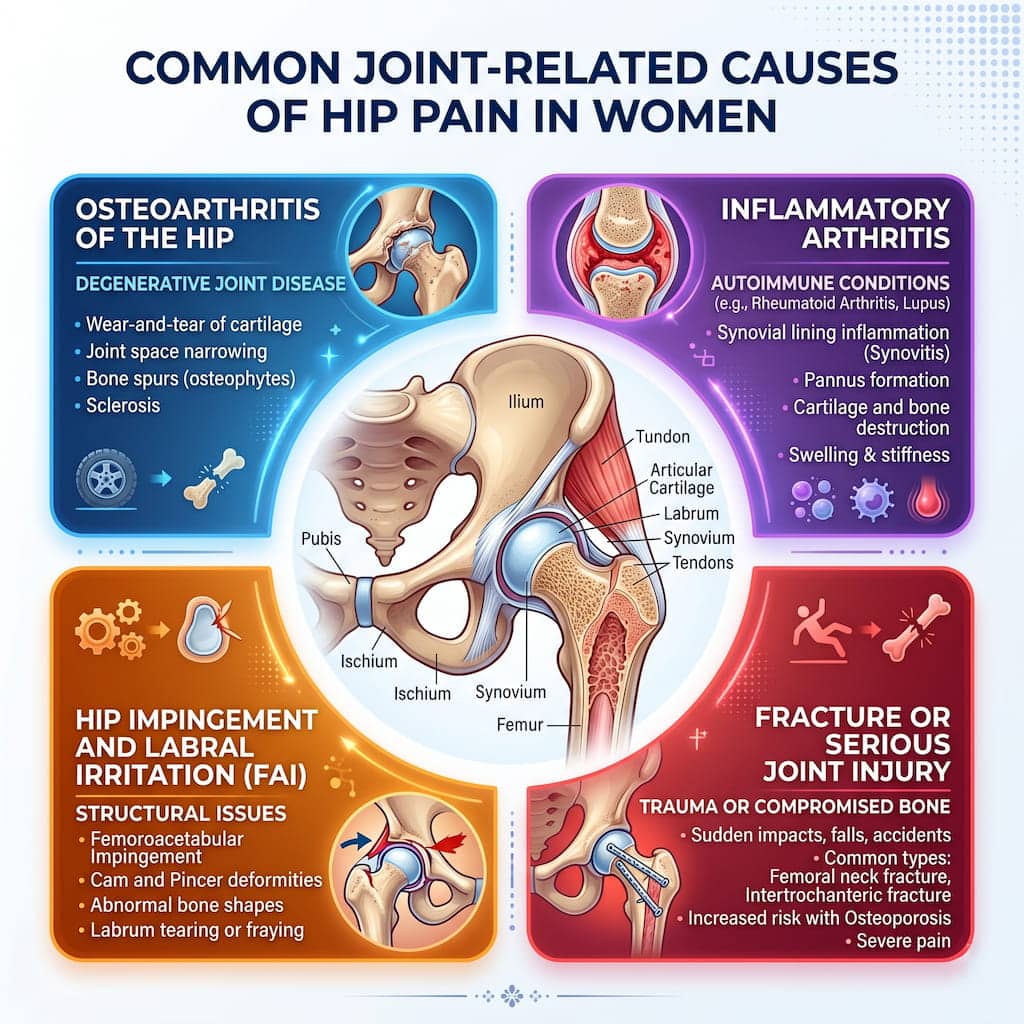
Common Joint Related Causes of Hip Pain in Women
Osteoarthritis of the hip
One of the most common causes of hip pain in adults is osteoarthritis. This happens when the joint gradually changes over time and movement becomes more painful and stiff. Women, especially as they get older, may notice groin pain, reduced flexibility, difficulty putting on shoes, pain during walking, or stiffness after rest. It usually builds gradually rather than appearing overnight.
A lot of people assume arthritis means constant severe pain, but that is not always true. Sometimes it starts as a subtle loss of motion. Maybe turning in bed feels awkward. Maybe long walks feel heavier than they used to. Maybe standing after a movie feels stiffer than expected. Those small changes matter.
Inflammatory arthritis
Not all arthritis is wear and tear. Inflammatory arthritis, such as rheumatoid arthritis or psoriatic arthritis, can also affect the hip. In these cases, stiffness may be worse in the morning, there may be pain in multiple joints, and symptoms can flare in patterns that do not quite match typical overuse pain. If someone has fatigue, swelling in other joints, or a known inflammatory condition, this becomes more important to assess properly.
Hip impingement and labral irritation
Hip impingement, also called femoroacetabular impingement or FAI, can cause groin pain, stiffness, limping, and pain with squatting, twisting, pivoting, or sitting for long periods. The labrum is a ring of cartilage around the socket of the hip, and it can become irritated or torn. These problems are more common in active adults, but they can also show up in people who are not athletes.
This kind of pain often feels sharp with certain movements and dull at other times. That pattern can make it frustrating because the hip may feel almost normal on one day and then suddenly pinch on the next.
Fracture or serious joint injury
Hip fractures are more urgent and often happen after a fall or direct trauma, particularly in older adults or people with bone weakness. Severe pain, inability to bear weight, or a noticeable change in leg position should never be brushed off. That is not the time for guessing.
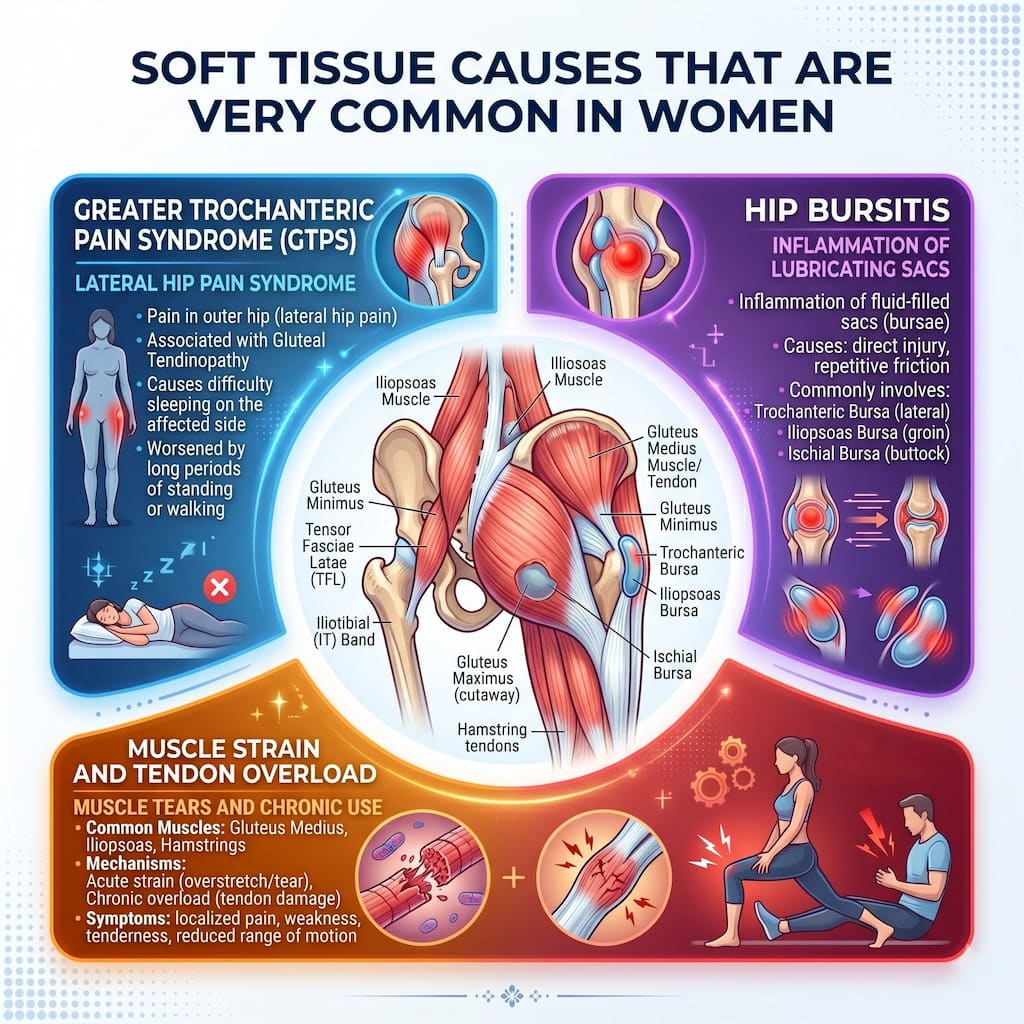
Soft Tissue Causes That Are Very Common in Women
Greater trochanteric pain syndrome
This is one of the most common reasons women feel pain on the outer side of the hip. It is a broader term that can involve tendon irritation around the hip and sometimes bursitis. Many women notice it when sleeping on one side, standing after sitting, crossing the legs, or doing repetitive walking.
Honestly, this is one of those problems people often misread. They think, “It must be my joint,” when the main issue is actually the irritated tissue around the side of the hip. The treatment approach can be quite different, which is why an accurate assessment matters.
Hip bursitis
Bursae are small fluid filled sacs that help reduce friction near joints. When one becomes irritated, pain can develop around the hip, especially on the outside. Hip bursitis may be associated with repetitive movement, pressure on the area, altered walking mechanics, or overload. It is often discussed together with other outer hip pain conditions because the symptoms can overlap.
Muscle strain and tendon overload
Sometimes the cause is much more mechanical. A sudden increase in walking, gym training, hiking, running, stair work, or even a long active weekend can irritate muscles and tendons around the hip. This is especially common if the body is deconditioned, if recovery is poor, or if one area is compensating for weakness somewhere else.
A woman might say, “I did not injure myself, but it started after I became more active.” That still counts as a useful clue. Pain does not always need one dramatic injury to begin. Sometimes it is simply too much load, too soon, with not enough support from strength and control.
Causes Linked to Pregnancy and Postpartum Changes
Pregnancy and the postpartum period can absolutely affect the hips. Changes in body mechanics, ligament laxity, pelvic loading, reduced sleep, lifting demands, and altered movement patterns can all contribute to discomfort in and around the hip.
Pregnancy related hip and pelvic strain
As the body changes during pregnancy, posture and weight distribution shift. The pelvis and surrounding muscles often have to work differently. That can create pain around the hip, buttock, groin, or pelvic region. Sometimes the issue is not a single injured structure, but rather a combination of load, instability, weakness, and sensitivity.
Postpartum pain and recovery demands
After delivery, the body does not instantly return to baseline. New lifting patterns, feeding positions, carrying the baby, sleep disruption, and reduced core and pelvic support can all keep stress on the hips and pelvis. Some women feel better within weeks. Others notice persistent pain that deserves proper assessment rather than being dismissed as “just postpartum.”
Menopause, Bone Health, and Hip Pain
Bone health becomes more important with age, especially after menopause. Lower bone density increases the risk of fragility fractures. This does not mean every woman with hip pain has a fracture, but it does mean persistent pain after a fall or unexplained severe pain should be taken seriously.
At the same time, many women in midlife and later life also deal with osteoarthritis, tendon irritation, and reduced strength around the hip. So the goal is not to assume one cause based on age. The goal is to look at the full picture.
Pelvic and Gynecologic Problems Can Sometimes Feel Like Hip Pain
This part gets overlooked a lot. Not every pain near the hip is truly from the hip joint or outer hip tissues. Some women experience pelvic pain that seems to wrap into the groin, side of the hip, or lower abdomen. In these cases, the symptom map can be misleading.
Pelvic floor dysfunction, pregnancy related pelvic strain, and other pelvic issues may contribute to discomfort that overlaps with what people call hip pain. That is one reason a broader clinical view is useful, especially when symptoms do not fit a straightforward muscle strain or joint stiffness pattern.
Referred Pain From the Lower Back or Nerves
The hip does not work alone. The lower back, pelvis, and nerves all interact with it. Sometimes the painful area is the hip, but the source is elsewhere. Lower back irritation can create pain in the buttock, side of the hip, or upper thigh. Nerve related pain may burn, travel, or change with sitting and bending.
Let’s be real, this is where online self diagnosis often falls apart. Two people can both say “my hip hurts,” but one may have outer hip tendon pain while the other has referred pain from the lumbar spine. The words sound similar. The treatment path is not.
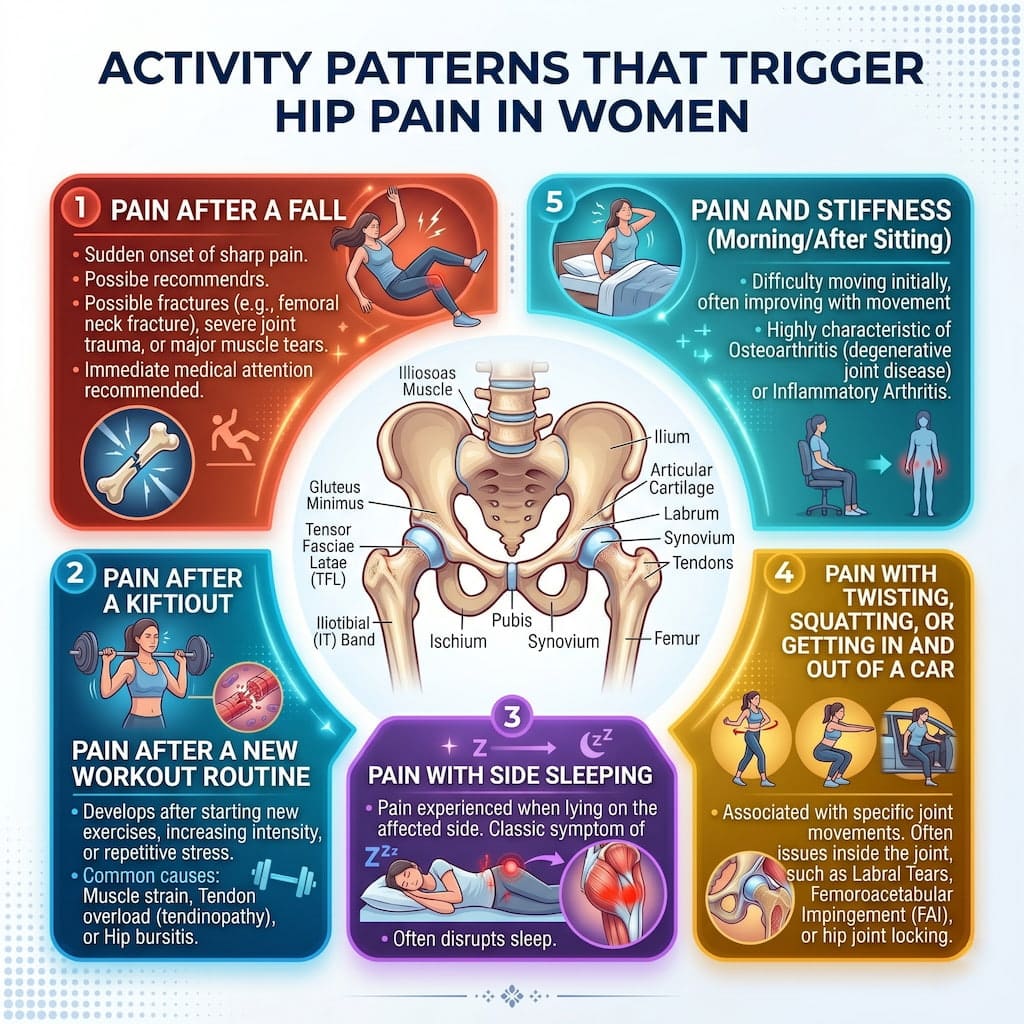
Activity Patterns That Trigger Hip Pain
The way pain starts often tells an important story.
Pain after a fall
This raises concern for fracture, joint injury, or serious soft tissue damage, especially if walking becomes difficult.
Pain after a new workout routine
This may suggest muscle overload, tendon irritation, or a flare of a pre existing weakness or imbalance.
Pain with side sleeping
This often points toward outer hip pain conditions such as greater trochanteric pain syndrome or bursitis.
Pain with twisting, squatting, or getting in and out of a car
This can be seen with hip impingement or labral related irritation.
Pain and stiffness first thing in the morning or after sitting
This pattern can suggest osteoarthritis or other joint irritation.
Symptoms That Should Not Be Ignored
Some hip pain is mild and settles with time, load modification, and the right rehab plan. But some symptoms deserve prompt medical attention.
Seek urgent medical care if hip pain follows an injury and you cannot stand or walk properly, if the hip or leg looks deformed, if you cannot move the hip, or if the pain is severe and sudden. Fever, sudden swelling, skin color change, or a leg that appears shortened or turned outward are also more serious signs.
Even when it is not an emergency, pain that keeps coming back, interrupts sleep, limits walking, or does not improve over time deserves a proper assessment. That is especially true if you are guessing and trying random stretches without knowing the actual cause.
How Hip Pain Is Usually Assessed
A good assessment usually looks at several things together: where the pain is, what movements trigger it, when it started, whether it follows injury or gradual overload, how walking is affected, and whether there are symptoms coming from the back, pelvis, or nerves. In some cases, imaging is useful. In many cases, the clinical pattern is already highly informative.
The important part is not just naming a condition. It is figuring out what is actually driving the pain in real life. Is it load sensitivity? Weakness? Joint stiffness? A movement problem? Referred pain? Tissue irritation from pregnancy or postpartum strain? A fall? That is what shapes the right plan.
How Capilano Physiotherapy Clinic May Help
At Capilano Physiotherapy Clinic in North Vancouver, the services listed on the clinic site that may be relevant to hip pain include musculoskeletal physiotherapy, pelvic floor physiotherapy, registered massage therapy, kinesiology, osteopathy, and care for acute and chronic pain or musculoskeletal injuries. The clinic also highlights one on one care, guided exercise, hands on treatment, and practical home advice.
For hip pain, the most helpful starting point is usually a proper assessment to identify whether the pain seems more related to the hip joint, outer hip soft tissues, pregnancy or postpartum mechanics, pelvic floor involvement, general movement dysfunction, or referred pain from nearby areas. From there, depending on the presentation, helpful care may include manual therapy, soft tissue treatment, guided strengthening, mobility work, movement retraining, and a home exercise plan. The clinic site also notes modalities such as therapeutic ultrasound, electrical stimulation, laser, taping, and IMS dry needling when appropriate.
If hip pain is linked to muscle tightness, overuse, or movement imbalance, services such as musculoskeletal physiotherapy, kinesiology, RMT, or dry needling may be relevant. If symptoms overlap with pelvic or postpartum issues, pelvic floor physiotherapy may also be worth discussing. The point is not to throw every service at the problem. The point is to match the care to the actual driver of pain.
If you live in Vancouver or North Vancouver and want guidance on what type of care may fit your symptoms, you can contact Capilano Physiotherapy Clinic for a free consultation at (778) 743-6090. The clinic is located inside Capilano Mall at 935 Marine Dr Main Floor, North Vancouver, BC.
Conclusion
Hip pain in a woman can come from many different causes, including osteoarthritis, tendon irritation, bursitis, labral or impingement related problems, pregnancy and postpartum changes, pelvic issues, referred pain from the back, and in more serious cases, fracture or major injury. Really, the most useful clues are not just the pain itself, but where it is felt, what triggers it, how long it has been going on, and whether there are red flag symptoms. A careful assessment can make the situation much clearer and help guide the next step instead of relying on guesswork.
FAQs
Is hip pain in women usually caused by arthritis?
Not always. Arthritis is one common cause, especially with age, but hip pain can also come from tendons, bursae, muscles, the labrum, the lower back, pregnancy related changes, or pelvic issues.
Why does my hip hurt when I lie on one side?
Pain when lying on one side is often associated with outer hip pain conditions such as greater trochanteric pain syndrome or bursitis.
Can pregnancy cause hip pain on one side?
Yes. Pregnancy can affect the hips and pelvis because of changing mechanics, load, and musculoskeletal stress. One sided pain can happen depending on how the body is adapting and moving.
When should hip pain be treated as urgent?
Urgent care is important if the pain follows trauma, if you cannot stand or walk properly, if the hip looks deformed, if you cannot move it, or if there is severe sudden pain, fever, or swelling.